Case prep for plastic surgery residents

Prepare for tomorrow’s case in 5–15 minutes.

Pick the operation and your training level, then scroll the questions your attending is likely to ask. Learn the consensus, see where surgeons disagree, and understand why.

Download on theApp StoreRead a real sheet

For iPhone · Free during the initial launch · Android coming soon

27 plastics cases PGY-1 to PGY-4+ Sources on every answer
Your next case, ready
PGY-1 to PGY-4+
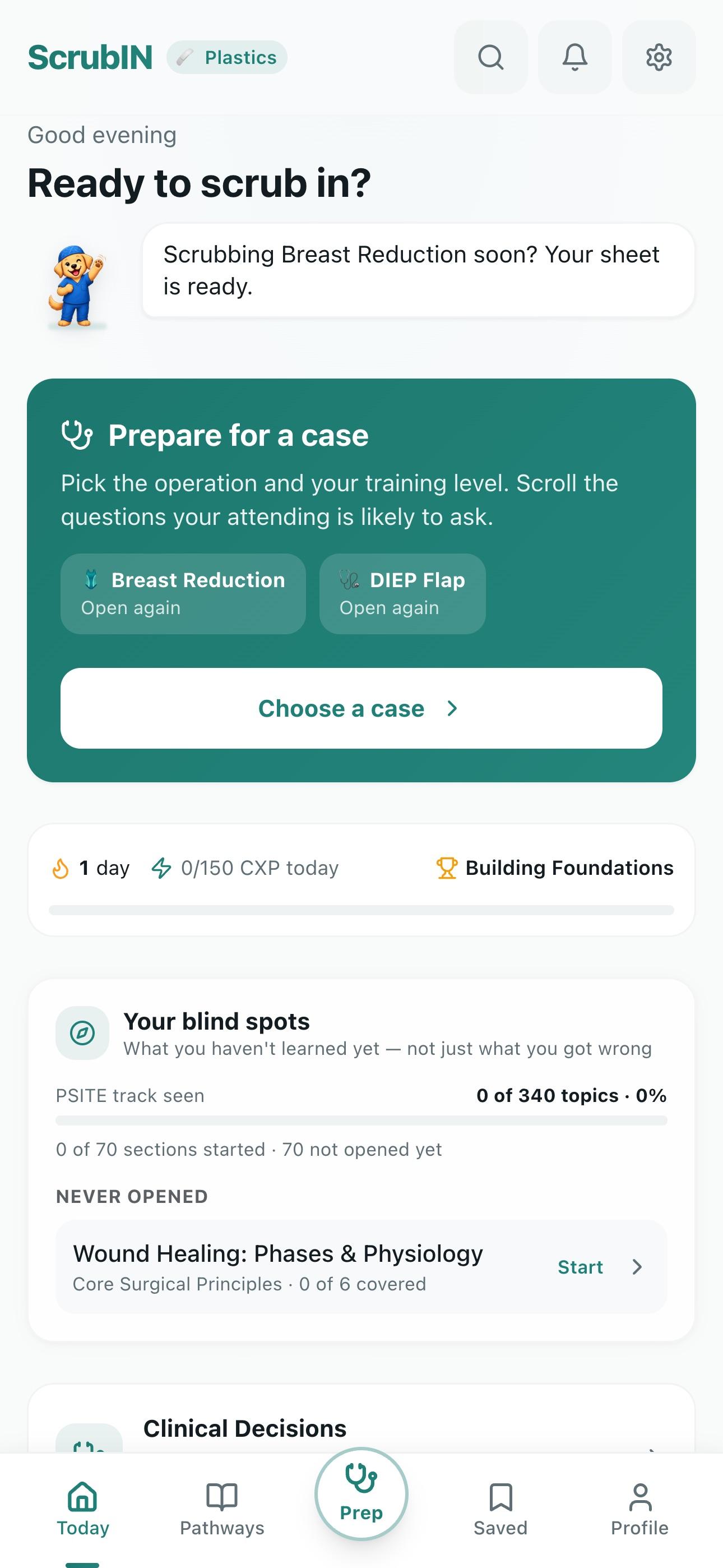
ScrubIN Today screen: a Prepare for a case card with Breast Reduction and DIEP Flap ready to open again, and a Choose a case button.
Koji, the ScrubIN guide

ScrubIN in 32 seconds

Be ready for the next case.

Pick your operation, PGY level, and 5–15 minutes. Learn the core knowledge, pearls and pitfalls, and why surgical approaches differ. Hop between Pathways islands: short lessons, steady progress, streaks, and badges in a lower-pressure space.

Prepare for tomorrow’s case in 5–15 minutes. Sound on for the launch film.

Current app screens. Community comments, agrees, and contribution badges are beta previews with illustrative content. Case sheets remain AI drafts until surgeon review.

Music: “Feels Good To Be” by Jason Shaw / Audionautix, CC BY 4.0. Excerpt, tempo and mix edited for ScrubIN.

Case Prep

The night before, or the minutes before.

Case Prep is one scrolling sheet per operation. Open it, choose how deep to go, and read. Here is what that looks like in the app.

  1. 1 · Pick the case

    One sheet per operation

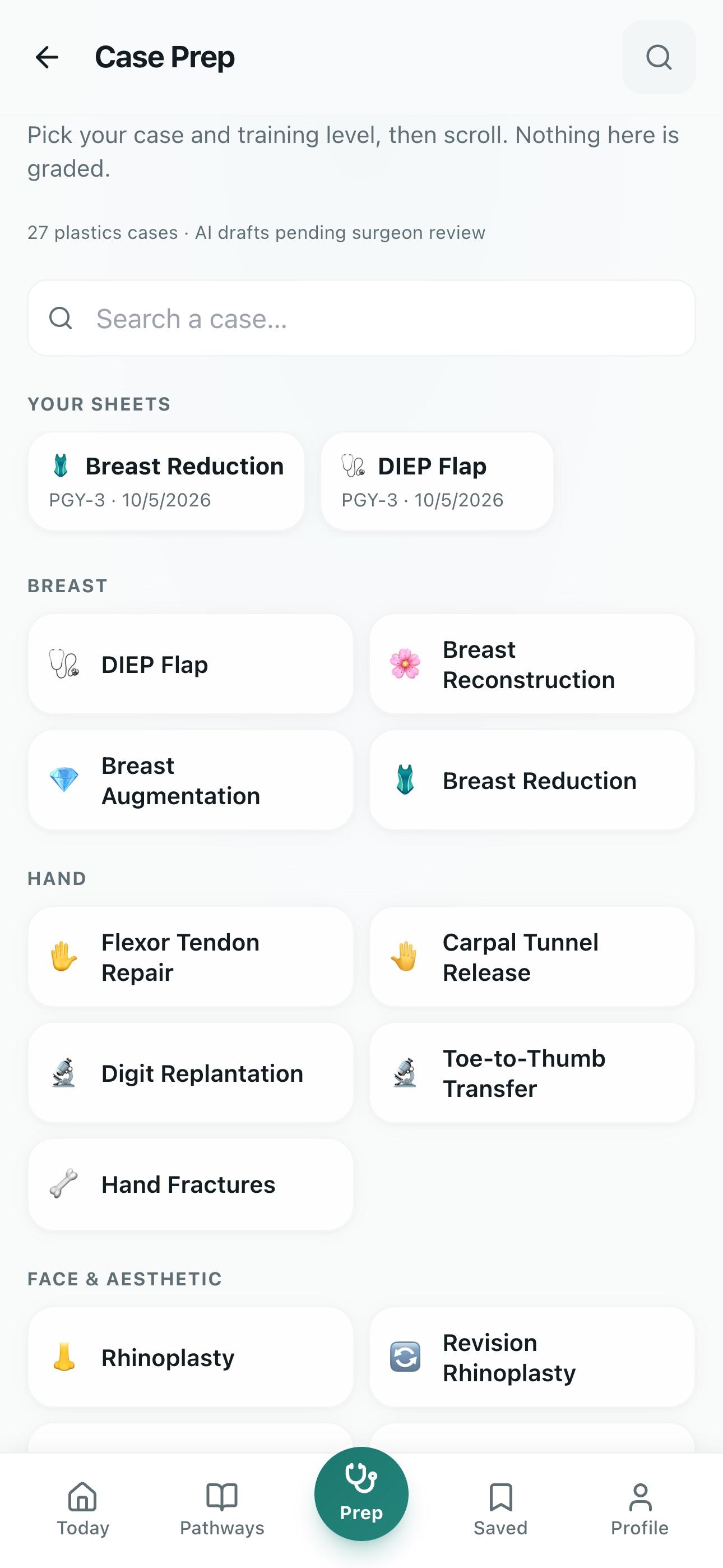
    27 plastics cases, from breast reduction and DIEP flap to flexor tendon repair, cleft lip, rhinoplasty and burn excision. Your recent sheets stay at the top.

    BreastHandFace & aestheticBurnReconstruction & wounds
    ScrubIN Case Prep list: 27 plastics cases grouped by Breast, Hand and Face and aesthetic, with a case search and your recent sheets at the top.
  2. 2 · Pick your level and time

    Scroll the questions your attending is likely to ask

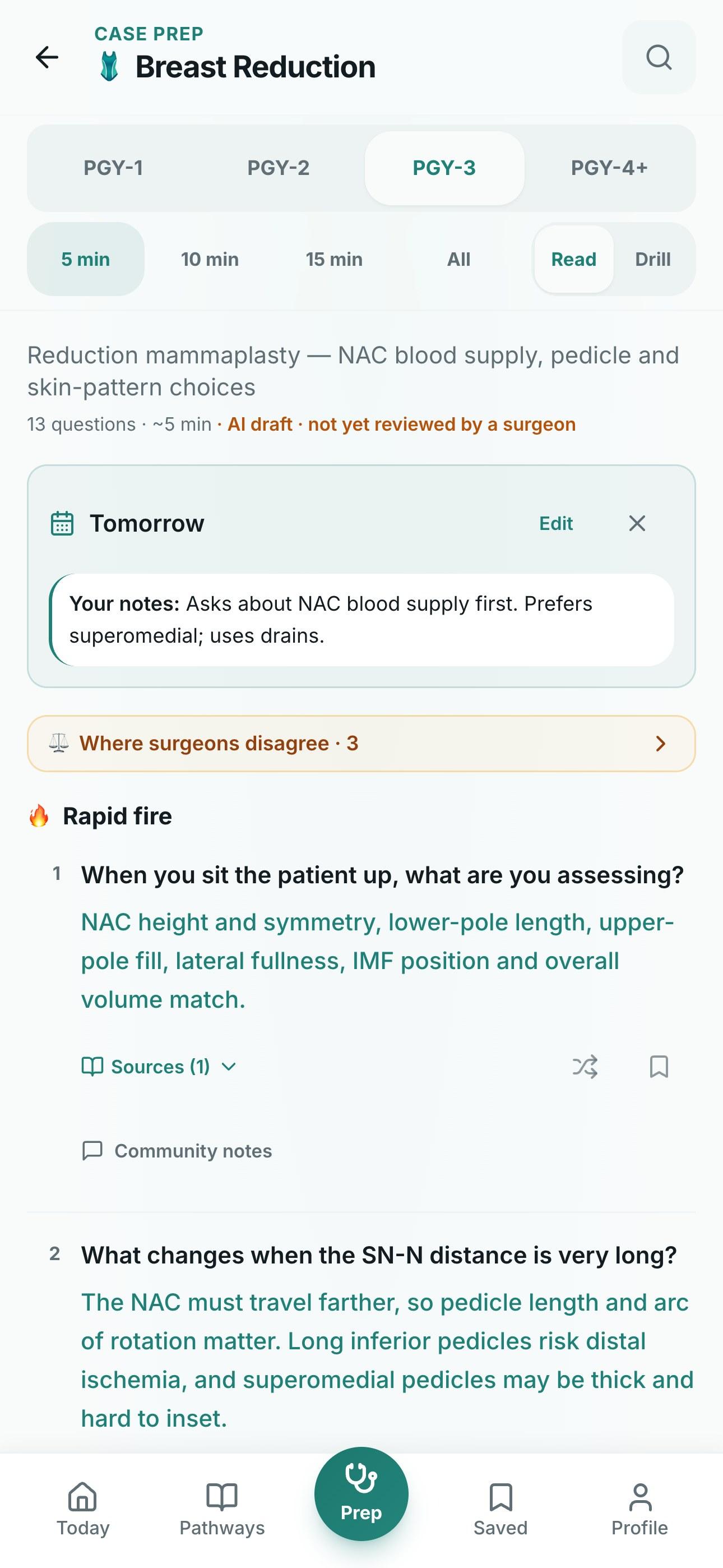
    Your training level changes what you are asked, not only how hard it is. Time sets the depth. Answers are visible as you scroll, sources are linked, and nothing is graded.

    PGY-1 to PGY-4+5 · 10 · 15 min · AllSources on every answer
    A Breast Reduction prep sheet at PGY-3 and 5 minutes: tomorrow's case with your notes on it, then rapid-fire questions with the answers shown and sources linked. The sheet is labeled AI draft, not yet reviewed by a surgeon.
  3. 3 · See where surgeons disagree

    The consensus, the disagreement, and why

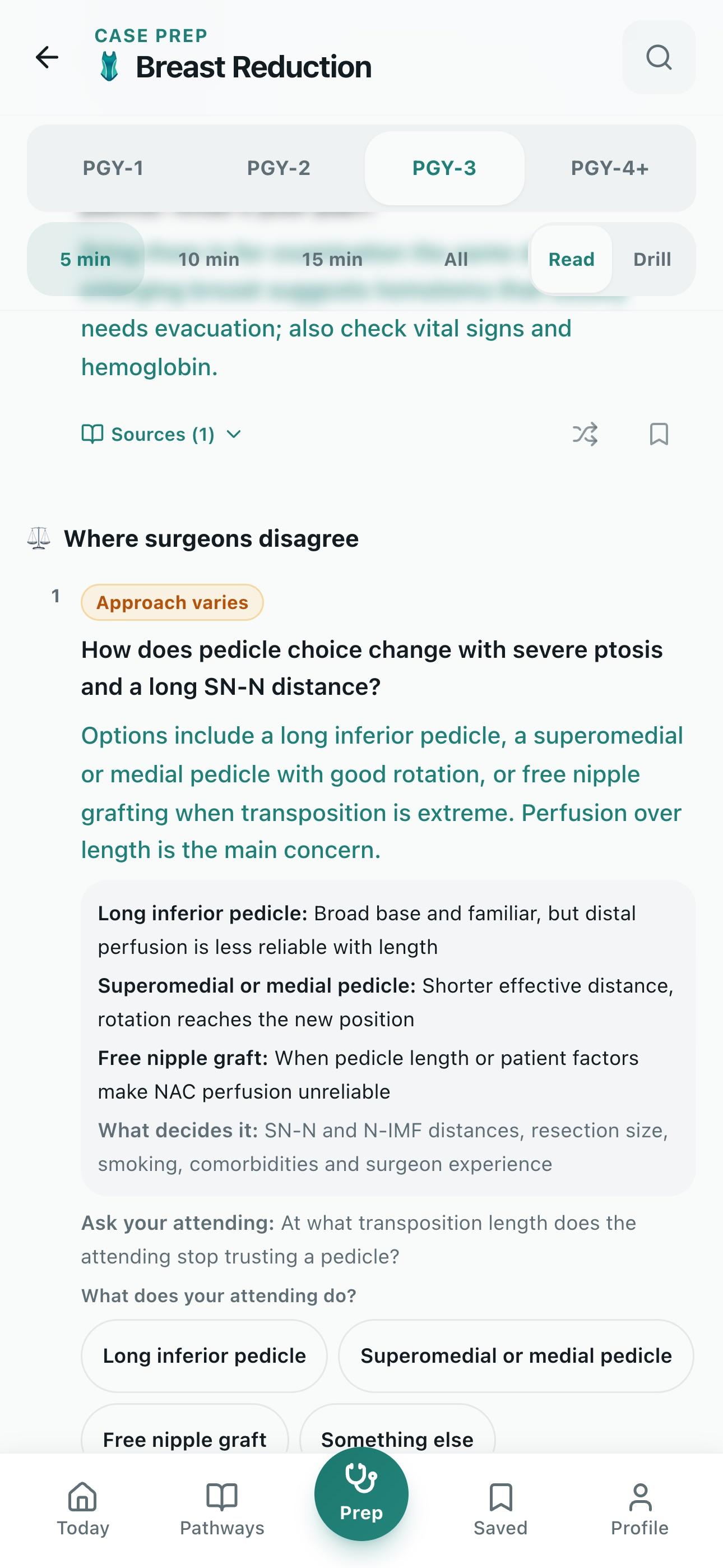
    Where practice varies, the question is labeled. You see the common approaches, what drives the choice, and a question to ask your attending.

    Approach variesEvidence uncertainAsk your attending
    Where surgeons disagree on the Breast Reduction sheet: a question labeled Approach varies, showing three approaches and why each is chosen, what decides it, a question to ask your attending, and one-tap answers to What does your attending do?
  4. 4 · Drill it

    Say it, flip it, mark it

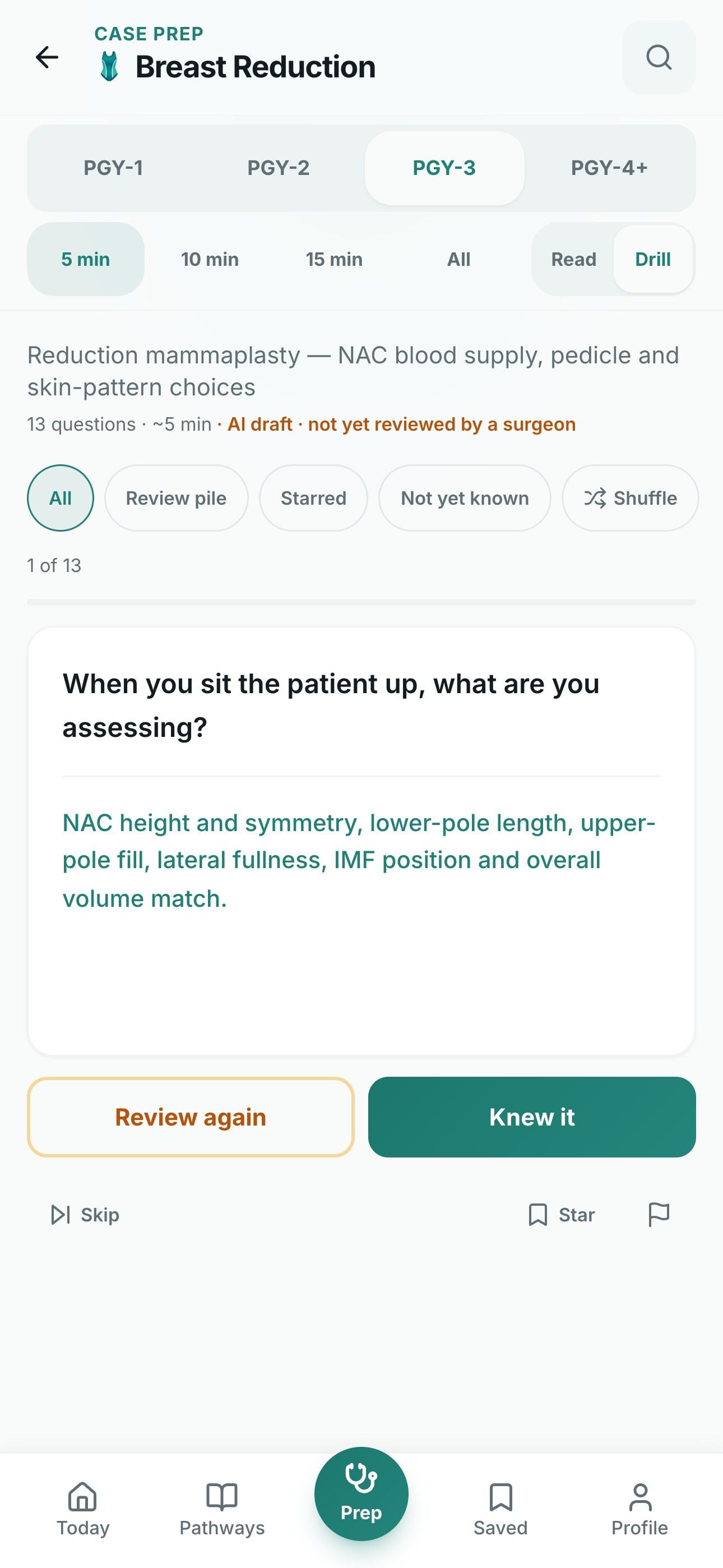
    Answer out loud, flip the card, then tap Knew it or Review again. The ones you missed come first next time, and each case keeps its own progress.

    Knew itReview againProgress per case
    Drill mode on the Breast Reduction sheet: one question with its answer showing, buttons for Review again and Knew it, and Skip and Star below.

Sources on every answer

Each answer links the textbook chapter, guideline or paper it draws on, so you can check it.

Labeled until reviewed

No sheet has been reviewed by a surgeon yet. Each says so until a named plastic surgeon reviews it.

Privacy-first

No patient data, no ads, and no selling learner data.

Try it here

Read two questions from a real prep sheet.

Copied exactly as they appear on the Breast Reduction sheet in ScrubIN, with the same labels, sources and review notice. The answers are right there. Nothing is graded.

Educational example. Use institutional protocols and supervising-team guidance for patient care.

Case Prep · Breast Reduction

AI draft · not yet reviewed by a surgeon

  1. Core knowledgePGY-2

    Question 1: Why do we tailor-tack before final excision?

    Temporary staples let you sit the patient up, judge shape, symmetry and NAC position, and adjust skin or parenchyma before committing to irreversible excision.

    Sources (1)
  2. Approach variesPGY-1

    Question 2: Why might one patient get a Wise pattern and another a vertical pattern?

    Wise removes skin in two directions and suits larger breasts with lots of excess skin; vertical avoids the IMF scar and can give more projection but has a learning curve and settles over weeks.

    Wise (inverted-T): Predictable skin control in large, ptotic breasts

    Vertical: Shorter scar and good projection in small to moderate reductions

    What decides it: Resection size, skin excess and elasticity, and surgeon experience

    Ask your attending: What pattern was marked, and why for this patient?

    What does your attending do?

    One tap. In the app, results across residents show once five have answered.

    Sources (2)

The full sheet is in the app.

About 100 questions per case across PGY-1 to PGY-4+, for 27 plastics cases. Pick 5, 10 or 15 minutes, or read it all.

Download on theApp Store
Built for plastic surgery residents

Your level changes the questions, not just the difficulty.

The same operation asks different things of an intern and a chief. Pick your training level on any sheet and switch it whenever you like. Senior levels keep the foundations underneath.

PGY-1

Anatomy and recognition

The anatomy, the steps and the vocabulary, so you can follow the operation and answer the first questions.

PGY-2

Applied anatomy

Why the anatomy matters for this patient and this operation, and the clinical reasoning that goes with it.

PGY-3

Operative decisions

Which technique, which pedicle, which pattern, and what changes the plan in the room.

PGY-4+

Judgment and tradeoffs

What the evidence does and does not settle, how to counsel, and how to weigh one approach against another.

Medical students on a plastics rotation start at PGY-1 depth.

Your notes

Every attending does it a little differently. Write it down.

The sheet gives you the consensus. Your notes keep what your attending actually does, attached to the question and the case.

  • My attending does it differently

    Tap it on any question to save your own note on how your attending does it. Your notes follow your account to a new phone.

  • Add tomorrow's case

    Add a case for today, tomorrow or a date. The sheet shows it at the top.

  • Notes for the case

    Keep notes on what your attending asks and prefers for this case. No names or initials: the field is small enough that initials identify a surgeon.

  • A reminder the evening before

    Get a reminder the evening before so the sheet is read before you scrub, not in the hallway.

Upcoming cases and your notes on them stay on your phone. Never enter names, initials or patient details.

Explore ScrubIN · 60 seconds

Prepare for tomorrow. Learn for the long run.

See how Case Prep and Pathways work together: choose your PGY level and time, practice rapid-fire recall, explore surgeon perspectives, and hop between short lessons with streaks and badges.

Sound on for Liam’s product walkthrough. English captions available.

Current app screens. Community comments, agrees, and contribution badges are beta previews with illustrative content. Case sheets remain AI drafts until surgeon review.

Music: “Feels Good To Be” by Jason Shaw / Audionautix, CC BY 4.0. Excerpt, tempo and mix edited for ScrubIN.

27

Plastic surgery cases, one prep sheet each

~100

Questions per case, across training levels

4

Training levels: PGY-1, 2, 3 and 4+

5–15

Minutes per sheet, or read it all

Plastic surgery only, for now. Every answer links its sources, and every sheet shows its review status.

Also in the app

Between cases, build the foundations.

  • Pathways

    A core-knowledge curriculum laid out as an island map, for when there is no case tomorrow.

  • Quiz me

    Scored practice on core knowledge. Only core-knowledge questions are scored; prep sheets never are.

  • Clinical Decisions

    Step through a clinical case one decision at a time, then read the debrief.

Koji, our Golden Retriever, is your guide through the app. He stays out of the way while you prep.

Coming later

  • Surgeon Perspectives: how invited surgeons approach the questions where practice varies, and why
  • More specialties, each once it has its own clinical reviewer

Not available yet. We will not describe these as features until they ship.

The story

Zero percent correct.

I was studying. The problem wasn’t effort.

I couldn’t convert what I read into answers when an attending turned and asked me a question in the OR. The 15 minutes between cases? I spent them Googling. Frantically. In a panic.

0% correct.

That’s where I started. Not because I didn’t know the material, but because I had no structured system to retrieve it under pressure, in that context, in that moment.

Then I switched to active, Socratic, case-based recall. The way attendings actually teach in the OR. I began consistently answering 50 to 75% of OR questions correctly. My competency kept increasing as the repetitions added up.

That delta is ScrubIN.

Read the founding story →

Frequently asked

What is Case Prep?

One scrolling sheet per operation, for 27 plastic surgery cases. Pick your training level (PGY-1, 2, 3 or 4+) and how long you have (5, 10 or 15 minutes, or All), then scroll the questions your attending is likely to ask. Answers are visible as you read, and nothing is graded.

What do Read and Drill do?

Read shows every question with its answer, sources linked. Drill turns the same questions into flashcards: say the answer, flip the card, then tap Knew it or Review again. The ones you marked Review again come first next time, and each case keeps its own progress.

What do the labels mean?

Core knowledge: anatomy, physiology or principles that do not depend on technique. Approach varies: several reasonable approaches, and the answer explains what drives the choice. Evidence uncertain: the literature does not settle it yet, and the answer says what is known and what is not. Labeled questions show the common approaches, what decides between them, and a question to ask your attending.

Is the content reviewed by surgeons?

No sheet has been reviewed by a surgeon yet. Sheets are drafted with AI from cited sources, and each will be reviewed by a named plastic surgeon. Until then, the app labels it “AI draft · not yet reviewed by a surgeon.” Every answer links its sources so you can check it. ScrubIN is for education and never replaces supervision, institutional protocols, or clinical judgment.

Is ScrubIN free?

Yes, during the initial launch, and Case Prep is included. No ads, and we do not sell your data. If paid features are introduced later, pricing will be shown clearly before you pay for anything.

Is it only for plastic surgery?

For now, yes. We would rather do one specialty properly. Other specialties will come once each has its own clinical reviewer.

How is this different from a question bank?

Question banks are built for sitting down to study, and every question has one right answer. Case Prep starts from the operation on your schedule, is never graded, and shows where surgeons disagree and why, so you can ask your attending about it. For core knowledge, the app also has Pathways and a scored Quiz me.

Does the app work without signal?

Case Prep sheets are built into the app, so they open without a connection. Opening a linked source, seeing what other residents' attendings do, and syncing your notes to your account need a connection.

Does ScrubIN use AI?

To draft content, yes. AI drafts sheets from cited sources, and plastic surgeons review them; until a sheet is signed off, the app says so. Inside the app there is no AI answering your questions.

Who's behind ScrubIN?

Jane Ewing, MD — a Plastic Surgery Resident at Loyola University Chicago — is co-founder and Chief Medical Officer. She defines what the product teaches, how content is reviewed, and which clinical problems it solves. Nate Ewing is co-founder and Chief Product Officer, leading product, engineering, analytics, and growth. They are married co-founders based in Chicago, and their Golden Retriever Koji became the app's learning guide.

Is this affiliated with a hospital or program?

No. ScrubIN is operated by Scrubin Medical Education LLC, an independent company. We do not claim institutional endorsements.

When is Android coming?

It is in development. iOS is available first; you can leave your email to be notified when Android ships.

How do I report a mistake?

On a prep sheet, tap “My attending does it differently” on the question, write your note, and tick “Also share with Scrub In” so it reaches our review queue. Quiz questions have a flag with reasons such as “Content incorrect.” Or email hello@getscrubin.com. Include a source if you can.

Android coming soon. Get notified.

One email per shipped milestone. No spam, no sales.

Pricing

Free during the initial launch. Case Prep included.

No ads. No data sold. If paid features come later, we’ll show the price clearly before you pay for anything.

Walk into tomorrow’s case prepared.

27 plastic surgery cases, your level, 5 to 15 minutes. Free during the initial launch, Case Prep included.

Download on the
App Store
Coming soon
Android